
We are working with others on closing the loop
In order to achieve our ambitions, we are committed to promoting circularity and the efficient use of resources in product design and raw material sourcing as well as working together with our value chain partners to develop better waste reduction and management
practices, both regarding our own operations and product end-of-life.
Examples of how we collaborate:
Supporting customers to meet EPR requirements
We help our customers meet evolving EPR requirements by offering them packaging that is designed to be recyclable, compostable or reusable, and by continuously innovating solutions that reduce environmental impact. We support customers with clear material choices, design‑for‑recyclability expertise, and transparent information to ensure their packaging performs in both product protection and regulatory compliance. Through active collaboration with policymakers and value‑chain partners, we work to strengthen recycling systems and create fair, functional EPR frameworks that enable our customers to transition confidently toward a circular economy.
Cup Collective
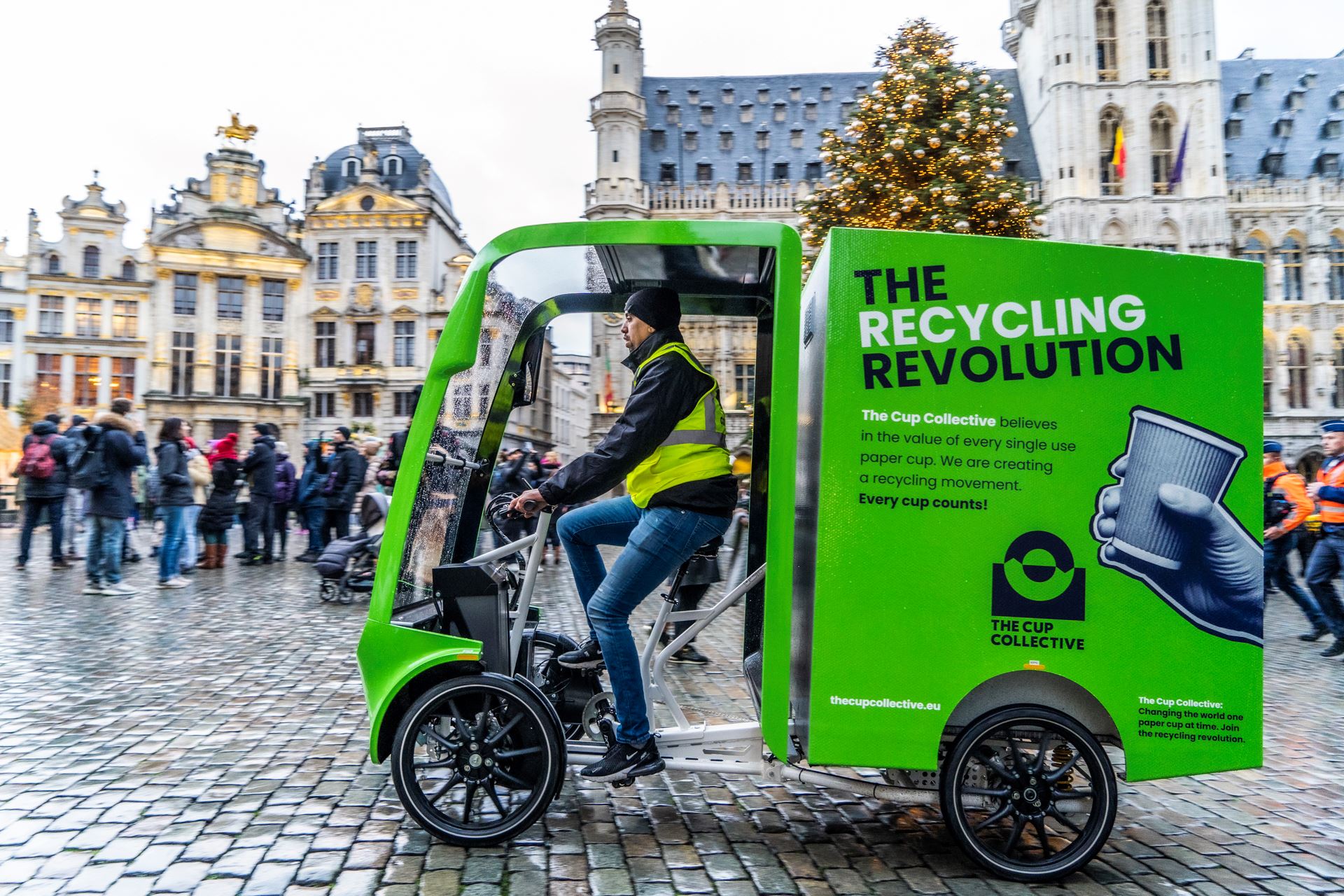
The Cup Collective is a commercial initiative that brings together an alliance of like-minded industry-leading organizations to meet the at-scale recycling challenge of single-use paper cups.
The initiative brings together industry leaders – including founding partners Huhtamaki, Stora Enso, as well as Coca-Cola, and McDonald's – to develop solutions that benefit both businesses and consumers.
Read more about the Cup Collective
Huhtamaki and Sporting Kansas City partnership

The partnership between Huhtamaki and Sporting Kansas City, a US National Soccer League club, aims to reduce the stadium’s environmental footprint through improved waste management.
The sponsorship began in 2023 to help divert waste from the landfill by assisting with compostable and recyclable packaging solutions. In the 2025 season, 59% of food and packaging waste was diverted from landfill. This demonstration is important in helping Huhtamaki and other customers understand consumer behavior in all elements of the circular economy.
Circularity and sustainable event management at Slush
In 2025, Huhtamaki partnered with Slush, one of world’s leading startup events held in Finland, to elevate sustainability at the event by setting a closed-loop recycling system for cups.
Huhtamaki supplied recyclable fiber cups, lids, and other food containers and ensured these materials were collected in dedicated bins throughout the venue. By partnering with a local recycler, Huhtamaki helped transform the used packaging items into new packaging solutions, showcasing the practical potential and scalability of sustainable practices. This approach not only supports the circularity of fiber materials but also serves as a model for sustainable event management.
Circulating printed plastic scrap back to the production in Türkiye
Huhtamaki’s first de-inking technology machine to process post-industrial waste has been installed in our Flexible packaging plant in Türkiye. Thanks to the initiative, 35-40% of the total printed plastic scrap generated in the production processes can go back to the process.
Replacing multi-material packaging
As consumer environmental awareness increases, brand owners are under growing pressure to redesign their packaging in favor of more sustainability-driven approaches. This trend drives large multinational consumer goods companies to seek alternatives to hard-to-recycle plastic packaging and shift toward circular solutions—such as paper-based packaging with compostable properties or recyclable flexible packaging.
Huhtamaki’s blueloop™ flexible packaging products offer a wide range of innovative solutions that address these challenges by replacing complex, multi-material packaging with simpler, mono-material options designed for recyclability. All Huhtamaki’s blueloop™ solutions are fit for recycling streams following blueloop™ circularity criteria. Transitioning to these solutions can also deliver additional environmental advantages, including reduced packaging weight and lower freight costs, which contribute directly to decreased CO₂ emissions.